Do You Need Rock Salt for an Ice Cream Maker?
Rock salt is a staple in old-fashioned churns, but most modern machines don't need it at all. Here is what actually matters for each type.
If you pulled out a hand-crank ice cream maker as a kid, you probably remember pouring rock salt over crushed ice and waiting what felt like forever. That memory makes the question reasonable: do you still need rock salt to make ice cream at home? The short answer is it depends entirely on which type of machine you have. Salt-churn makers require it. Freezer-bowl and compressor machines do not. This guide explains why salt works, which machines use it, and what your options are if you want to skip it.


Why Rock Salt Works in the First Place
Rock salt lowers the freezing point of water. When you pack ice and salt together around a canister, the mixture drops to temperatures well below 32 degrees F, sometimes reaching 15 to 20 degrees F. That super-cold brine pulls heat out of the ice cream base inside the canister far faster than plain ice can. The cream freezes while the paddle churns air in, giving you a smooth, scoopable texture rather than a solid block.
The salt itself never touches your ice cream. It works only in the space between the ice and the outer bucket. That is why the ratio matters: too little salt and the brine stays too warm; too much and it can freeze so fast the outside of the canister solidifies before the center churns properly. Most recipes call for roughly one cup of rock salt per three pounds of crushed ice, but always check your machine's manual for the specific ratio it recommends.
Machines That Require Rock Salt
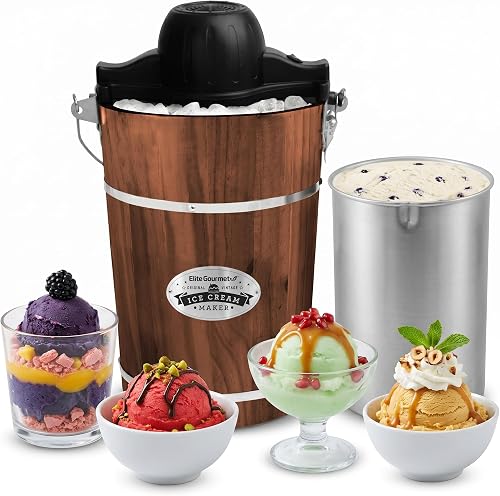
Traditional hand-crank churns and electric bucket-style ice cream makers rely entirely on the ice-and-salt method. These machines have an outer wooden or plastic bucket, an inner metal canister that holds the mix, and a dasher or paddle that spins inside. Without salt, the plain ice simply cannot get cold enough, fast enough, to freeze the base during the typical 20-to-40-minute churn time.
If your machine has an outer bucket that you fill with ice by hand, it almost certainly needs rock salt. Look at the instructions: they will list quantities of both ice and salt. Old-fashioned bucket churns in the 4-quart to 6-quart range are the most common examples of this style, and they remain popular for large summer batches and backyard gatherings.
The Elite Gourmet EIM949 is a good example of this style. It holds 6 quarts, is rated 4.4 stars across more than 3,400 reviews, and carries a wood-finish bucket that gives it a classic look. With a machine like this, rock salt is not optional; it is part of the recipe.
Machines That Do Not Need Rock Salt
Two popular types of modern ice cream makers skip rock salt entirely.
Freezer-bowl machines use a double-walled bowl pre-filled with a liquid coolant. You freeze the bowl overnight (or for at least 15 hours), then churn your base directly inside it. The frozen bowl does the same job the ice-and-salt brine does, without any mess. Cuisinart popularized this style, and the basic Cuisinart ICM100T is one of the more affordable entry points in this category.
Compressor machines are the most convenient option. They have a built-in refrigeration unit, similar to a small refrigerator, that chills the bowl automatically. You pour in your base, press start, and the machine does everything. No pre-freezing, no ice, no salt. The Whynter ICM-200LS is a well-regarded compressor model with a 2.1-quart capacity, stainless steel construction, and 4.5 stars across more than 4,500 reviews. Compressor machines cost more upfront, but they remove every variable from the process.
Can You Substitute Table Salt or Other Salts?
In a pinch, table salt works. It depresses the freezing point of water by the same chemistry as rock salt. The difference is grain size. Rock salt dissolves more slowly, which helps maintain a consistently cold brine as the ice melts over a longer churn. Table salt dissolves faster, which can cause the temperature to swing a bit more.
If you use table salt, start with about two-thirds the quantity the recipe calls for in rock salt and adjust from there. You may find the ice melts a little quicker, so have extra ice on hand.
Kosher salt also works but shares the same fast-dissolve limitation. Sea salt works too. What you want to avoid is flavored or iodized salts in large quantities, not because of chemistry but because spills into the canister could affect flavor. Any plain, non-iodized coarse salt is a reasonable substitute if rock salt is unavailable.
How Much Rock Salt Do You Actually Need?
A typical 4-quart electric bucket churn will go through roughly one to two pounds of rock salt per batch, depending on ambient temperature, how long the churn takes, and the starting temperature of your base. On a hot day, you may need to replenish ice and add a bit more salt halfway through.
For a 6-quart machine like the Elite Gourmet EIM949, plan on the higher end of that range. Rock salt is inexpensive and sold in large bags at grocery stores, hardware stores, and online. Buying a 10-pound bag gives you plenty of room to experiment without worrying about running short.
Store unused rock salt in a sealed container. It does not expire, but it can clump if it absorbs moisture from the air.
Tips for Getting the Best Results With a Salt-Churn Maker
Start with a cold base. Chill your cream mixture in the refrigerator for at least two hours before churning. The colder the base, the less work the ice-and-salt brine has to do, and the faster you get to soft-serve consistency.
Use crushed or chipped ice rather than whole cubes. More surface area between the ice and the salt means a colder, more even brine. Many grocery stores sell bags of crushed ice, or you can run cubes through a blender for a few seconds.
Layer as you fill. Alternate layers of ice and salt around the canister rather than dumping everything in at once. This creates more consistent contact between the salt and ice throughout the bucket.
Do not lift the lid of the canister during churning. Each time you open it, warm air rushes in and raises the temperature of the mix.
Once churning is done, pack the finished ice cream into a container and let it harden in the freezer for at least two hours. Straight out of the churn it will be soft; the freezer firms it up to a scoopable texture.
Which Type of Machine Is Right for You?
If you make ice cream a few times a year and enjoy the ritual of the process, a salt-churn machine is fine. They are inexpensive, durable, and make large batches well. The Nostalgia ICMP4BL, for example, holds 4 quarts, is rated 4.4 stars across more than 200 reviews, and comes in at a budget-friendly price point. Just buy a bag of rock salt and keep it on hand.
If you want less hassle, a freezer-bowl machine cuts out the salt and ice entirely. The tradeoff is that you must remember to freeze the bowl the night before. If you forget, you wait another day.
If you want maximum convenience and make ice cream often, a compressor machine like the Whynter ICM-200LS is the best long-term investment. No pre-planning, no consumables, just plug in and churn. The higher purchase price pays back over time in convenience and consistent results.
For questions about any of the machines on our site, feel free to reach out at hello@alluringdeals.com.
Frequently asked questions
Can I use my salt-churn ice cream maker without rock salt?
No. Plain ice without salt does not get cold enough to freeze the base in the typical churn time. The salt is what lowers the brine temperature below 32 degrees F. Without it, you will end up with a lukewarm, liquid mix after 30 minutes of churning.
How much rock salt goes in a 4-quart ice cream maker?
A common starting point is about one cup of rock salt for every three pounds of crushed ice. For a 4-quart machine, that usually means one to one and a half cups of salt total, though your machine's manual will give you the most accurate ratio for its specific bucket size.
Does the type of salt affect the flavor of my ice cream?
No, as long as the salt stays in the outer bucket and does not mix into the canister. The ice cream base never contacts the salt. If salt does get into your canister, it means the lid seal is compromised or the canister cracked.
What if I forgot to freeze the bowl for my freezer-bowl machine?
You will need to freeze it before using it. Most manufacturers recommend at least 15 hours in a standard freezer set to 0 degrees F. Trying to churn in a bowl that is not fully frozen results in a slushy mix that never sets properly.
Is a compressor ice cream maker worth the extra cost?
It depends on how often you make ice cream. If you churn a batch a week, the convenience of skipping pre-freezing or buying ice and salt makes a compressor machine well worth it. If you make ice cream two or three times a summer, a freezer-bowl or salt-churn model is more cost-effective.