Easy Homemade Ice Cream Recipes
A few simple ingredients and the right technique are all you need to make creamy, scoopable ice cream at home.
Homemade ice cream does not require fancy skills or a large investment. The basics come down to fat, sugar, and cold, and once you understand those three things, the recipes almost write themselves. Whether you have a compressor machine or a simple freeze-the-bowl model, the recipes below work with both. Start simple, nail the base, then branch out into flavors you cannot find at the grocery store.


The Standard Custard Base
A cooked custard base, sometimes called a French-style base, uses egg yolks to build richness and body. The general ratio is 2 cups of heavy cream, 1 cup of whole milk, 3 to 4 egg yolks, and three-quarters of a cup of sugar. Warm the milk and sugar together until the sugar dissolves, then slowly whisk the warm liquid into the beaten yolks to temper them, return everything to the pot, and cook over medium-low heat until the mixture coats the back of a spoon. Strain it, chill it in the refrigerator for at least 4 hours, and then churn. The egg yolks add emulsifiers that help the finished ice cream stay smooth and resist large ice crystals. This base is your foundation for vanilla, chocolate, coffee, and most mix-in recipes.
No-Cook Philadelphia-Style Base
If you want to skip the stovetop step, the Philadelphia style is the answer. It uses no eggs, just heavy cream, whole milk, sugar, and flavoring. Stir 2 cups of heavy cream with 1 cup of whole milk and three-quarters of a cup of sugar until the sugar fully dissolves, add a teaspoon of vanilla extract, and churn after a short chill. The result is a lighter, slightly less dense ice cream with a cleaner, brighter flavor, which makes it a good match for fresh fruit. The trade-off is that it melts a bit faster and can feel icier after a day in the freezer, so it is best eaten within 24 hours of churning. This is the fastest route from idea to dessert bowl.
Classic Vanilla, Chocolate, and Strawberry
Vanilla is the best recipe to start with because every variable is visible and there is nowhere for mistakes to hide. Use 2 teaspoons of pure vanilla extract, or split and steep a whole vanilla bean in the warm cream for a stronger flavor. For chocolate, whisk one-third of a cup of unsweetened cocoa powder and 2 ounces of melted dark chocolate into the warm base before tempering the eggs. For strawberry, macerate 1 cup of fresh or frozen strawberries with 2 tablespoons of sugar, mash them lightly, and fold the mixture into the churned ice cream during the last two minutes of spinning. All three flavors work in machines with a bowl as small as 1.5 quarts, like the Cuisinart ICE-100 (4.6 stars, 2,944 reviews, $379.95, 1.5 qt), which handles everyday batches without taking up much counter space.
Fruity Sorbets Without Dairy
Sorbet replaces the cream base with a fruit puree and a simple syrup, making it suitable for anyone avoiding dairy. The ratio that works reliably is 2 cups of fruit puree, three-quarters of a cup of simple syrup made from equal parts water and sugar and cooled, and a tablespoon of lemon juice to brighten the flavor. Mango, raspberry, and peach all work well. One practical note: fruit purees vary in water content, and a higher water content means more ice crystals after the sorbet hardens. Adding a tablespoon of vodka or corn syrup lowers the freezing point slightly and keeps the texture softer. Churn until thick and spoonable, then transfer to a container and freeze for at least two hours before serving.
Mix-Ins and Swirls
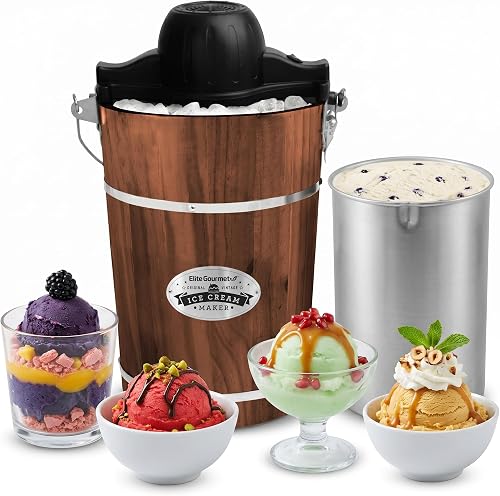
Add mix-ins during the last two to three minutes of churning, when the ice cream is thick enough to hold them in place but still moving. Chocolate chips, crushed cookies, toasted nuts, and candy pieces all work well. For swirls, such as caramel, fudge, or jam, layer them by alternating spoonfuls of churned ice cream and swirl material into the storage container before freezing. Do not stir or the swirl disappears into the base. A larger capacity machine gives you more room to work: the Elite Gourmet EIM949 (4.4 stars, 3,485 reviews, $89.99, 6 qt) is big enough for a generous batch with plenty of room to fold in mix-ins. For back-to-back batches without re-freezing a bowl, the Whynter ICM-200LS (4.5 stars, 4,558 reviews, $269.99, 2.1 qt) uses a built-in compressor that keeps it ready at any time.
Gelato-Style Ice Cream
Gelato uses more milk and fewer egg yolks than American-style ice cream, which gives it a denser texture and a more intense flavor. A basic ratio is 2 cups of whole milk, half a cup of heavy cream, 3 to 4 egg yolks, and two-thirds of a cup of sugar. Cook it like a custard, chill thoroughly, and churn at a slower speed if your machine allows it. The slower churn incorporates less air, which is what gives gelato its characteristic density compared to standard ice cream. Because the fat content is lower, gelato goes hard faster in the freezer, so pull it out 5 to 10 minutes before serving to let it soften. Pistachio, hazelnut, and lemon are natural fits for this style.
Storage and Serving Tips
Freshly churned ice cream is soft-serve consistency and needs two to four hours in the freezer to firm up for scooping. Press a piece of plastic wrap directly onto the surface before putting the lid on to block air and slow freezer burn. Wide, shallow containers freeze and thaw more evenly than deep ones. For the cleanest scoops, run your scoop under warm water between servings. Homemade ice cream is best within three to five days because it lacks the stabilizers that commercial products use to stay smooth over weeks. Label your containers with the flavor and the date so nothing sits too long.
Frequently asked questions
Do I have to pre-freeze the bowl before churning?
If you have a freeze-the-bowl machine, yes, the bowl must be completely frozen before you add your base, which typically means 24 hours in the freezer. You can tell it is ready by shaking it: if you hear liquid sloshing inside, it needs more time. Compressor machines do not use a pre-freeze bowl, so you can run consecutive batches without any waiting period between them.
Why is my homemade ice cream harder than store-bought?
Commercial ice cream contains stabilizers and is churned at controlled temperatures that keep it scoopable straight from the freezer. Homemade versions lack those stabilizers, so they freeze harder. The fix is to pull the container out of the freezer 5 to 10 minutes before serving, or to add a small amount of corn syrup or a tablespoon of vodka to the base to lower the freezing point slightly.
Can I make ice cream without a machine?
You can, but the texture will not be as smooth. The most reliable no-machine method is to freeze the base in a shallow metal pan, then break it up in a food processor once solid and refreeze. You can also whip heavy cream to stiff peaks and fold it into a sweetened condensed milk base, then freeze without churning at all, which gives a soft, mousse-like result that does not require any special equipment.
How much base should I make for a standard home machine?
Most home machines recommend filling the bowl no more than two-thirds full because the mixture expands as air is incorporated during churning. A 1.5-quart machine works best with about 3 to 3.5 cups of base. A 4-quart or 6-quart machine can handle proportionally more. Check your machine's manual for the maximum fill line before you start to avoid overflow during the spin.
Can I use low-fat milk instead of whole milk?
You can, but the result will be noticeably icier and less creamy. The fat in whole milk and heavy cream is what gives ice cream its smooth texture by coating ice crystals and slowing their growth. Substituting low-fat milk reduces that protective effect significantly. If you are looking for a lower-fat option, a dairy-free sorbet made from fruit puree is a better fit than trying to thin out a cream base.