How to Choose a Sous Vide Machine
The single most important spec is wattage: 800W heats slowly and struggles with cold water or large volumes, while 1000 to 1100W gets a full pot up to temp in a reasonable time. After wattage, check whether the clamp fits your tallest pot and whether the circulator reaches your target temperature accurately. Everything else, app connectivity, timers, display style, is a convenience layer on top of those two basics.
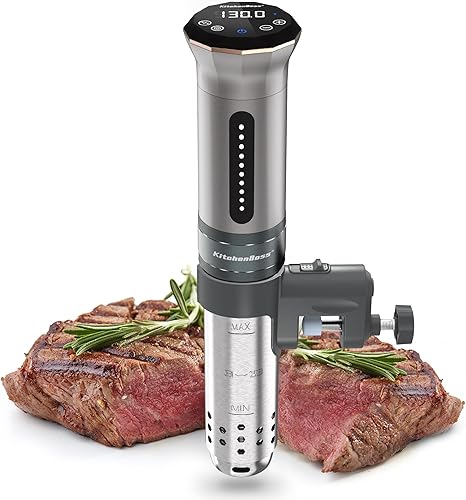


Immersion Circulator vs. All-in-One Water Oven
An immersion circulator is a wand you clamp onto any container you already own. An all-in-one water oven is a self-contained tub with a built-in heating element and no clamp. Circulators cost less, store easily, and let you scale container size to the job. Water ovens are quieter and keep evaporation lower over very long cooks, but they lock you into one fixed volume. For home use, a circulator is almost always the better starting point because it works with a $10 stockpot you already own.
Wattage and Heat-Up Time
Wattage controls how fast the circulator brings water to temperature and how well it recovers when you drop in cold food. An 800W model like the Monoprice 121594 (rated 4.2 stars across 657 reviews, $65.43) is capable for small pots but noticeably slower with a full 12-quart container. Models running at 1000 to 1100W, such as the Yedi Houseware GV024 at 1000W ($88.94, 4.6 stars, 1350 reviews) or the KitchenBoss G300 at 1100W ($105.99, 4.5 stars, 2255 reviews), recover faster after you add refrigerator-cold proteins. If you regularly cook for four or more people, lean toward 1100W. If you mostly cook single portions in a small pot, 800W is fine.
Container Capacity and Pot Compatibility
The circulator spec listed as capacity (in quarts) tells you the maximum water volume the unit can heat and circulate effectively. The KitchenBoss G300, for example, lists a 16.9-quart capacity, which covers a standard 12-quart cambro or stockpot with room to spare. The PolyScience CSV700PSS1BUC1 jumps to 47.6 quarts, a range that makes sense for catering or batch meal prep but is unnecessary for everyday family cooking. Most home cooks are well served by a circulator rated for 15 to 20 quarts. Also check the minimum water depth the unit requires, usually marked on the body, so it does not run dry with smaller batches.
Temperature Accuracy and Range
Sous vide cooking is all about precision, so temperature accuracy matters more than it does in any other cooking method. Look for a stated accuracy of plus or minus 0.1 to 0.2 degrees Fahrenheit. The top-end range is less critical for most recipes: steaks finish around 130 to 140 degrees F, chicken at 140 to 150 degrees F, and even the most demanding pasteurization targets fall under 165 degrees F. Where you do want headroom is at the low end for cold fermentation or gentle fish cooks around 104 to 110 degrees F. Verify the unit you pick covers that lower range, not just a high ceiling.
App Control and Manual Controls
Some circulators add Bluetooth or Wi-Fi app control, which lets you start or adjust a cook from another room. The KitchenBoss G300Px and G322PT both offer app plus touch controls on the unit itself, so you are never stranded if the app misbehaves. That redundancy matters: a circulator that requires the app for basic operation becomes unusable if your phone is unavailable or the app has a glitch. If you cook infrequently or prefer simplicity, a straightforward touch-panel model is easier to operate and has fewer points of failure. App control is a convenience, not a requirement.
Build Materials and Long-Term Durability
The shaft of the circulator spends a lot of time submerged in hot water, so stainless steel construction holds up far better than bare plastic over time. The Monoprice 121594 and KitchenBoss G300 both use stainless steel housings on the wetted parts. Plastic-body units can work well but may discolor or develop mineral deposits that are harder to clean. Whichever material you choose, descale the heating coil monthly with a diluted white vinegar soak if your tap water is hard, because mineral buildup reduces heating efficiency noticeably over time.
Common mistakes to avoid
- Buying a low-wattage model (under 900W) and then being frustrated by long heat-up times when using a large pot.
- Ignoring the minimum water depth spec and letting the circulator run partially exposed, which can burn out the motor.
- Skipping a lid or cover on the pot during long cooks, causing significant water evaporation that can drop the water level below the minimum line.
- Choosing a unit with app-only controls and then being unable to start a cook when the app or Bluetooth connection fails.
- Cooking directly in a zip-top bag without removing all the air, leaving air pockets that float the food out of the water and result in uneven cooking.
- Using a container that is too shallow, which limits circulation around the food and creates temperature gradients inside the bath.
Frequently asked questions
Do I need a vacuum sealer to use a sous vide machine?
No. A vacuum sealer produces the tightest seal and removes the most air, but a standard zip-top freezer bag works for most cooks. The key is using the water displacement method: submerge the open bag slowly so water pressure pushes air out, then seal it just above the waterline. This approach works well for steaks, chicken breasts, fish fillets, and vegetables. A vacuum sealer becomes worth it only if you sous vide frequently or want to pre-portion and freeze meals.
What size pot should I use with an immersion circulator?
A 12-quart stockpot is a practical all-around choice for home use. It holds enough water to cook four to six chicken breasts or two large steaks side by side without crowding, and most circulators rated for 15 to 20 quarts handle it easily. A smaller 8-quart pot works for single portions and heats up faster. Avoid very wide, shallow pots because they maximize evaporation and can make it harder for the circulator to maintain even temperature throughout the bath.
How long does it take to heat water with a sous vide circulator?
At 1100W, a 12-quart pot of tap water starting at roughly 60 degrees F typically reaches 130 degrees F in about 20 to 30 minutes. An 800W circulator running the same volume can take 35 to 50 minutes. Starting with hot tap water cuts that time significantly regardless of wattage. The heat-up wait is usually easy to plan around since most sous vide recipes have cook windows of several hours anyway.
Is there a difference between a $65 and a $106 sous vide circulator?
At that price gap, the main differences are wattage, build material, and capacity. The Monoprice 121594 runs at 800W with a stainless steel body and costs $65.43 with 657 reviews at 4.2 stars. The KitchenBoss G300 delivers 1100W, a 16.9-quart rated capacity, and earns 4.5 stars across 2255 reviews at $105.99. For occasional small-batch cooking the budget model is adequate. If you cook for a family or do longer batch cooks, the extra 300W and the higher-rated capacity of the step-up model are worth the difference.
Can I leave a sous vide machine running overnight or for 24 hours?
Yes, very long cooks are normal for certain cuts. Tough braising cuts like short ribs or pork shoulder are commonly cooked for 24 to 72 hours. For cooks over four hours, cover the pot tightly with a lid, plastic wrap, or silicone sous vide balls to minimize evaporation. Check the water level every eight hours or so to make sure the circulator remains properly submerged. Most circulators include a low-water auto-shutoff as a safety measure, but adding a cover makes that safety net much less likely to trigger.